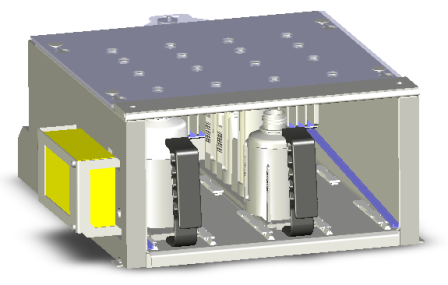
Reagent Bay Module Removal and Replacement

|
Laser Warning—This product utilizes internal barcode scanners with visible red laser light. Long term viewing of the laser light could result in eye damage. Never stare into the barcode scanner laser light. This is a Class 2 laser product in accordance to EN 60825-1: 2007 and complies with 21 CFR 1040.10 and 1040.11 except for deviations pursuant to Laser Notice N. 50, dated June 2007. |
Parts and Materials Required
- Slotted screwdriver
- Hex driver, 2.5 mm
- Hex driver, 3 mm
- Hex driver with long shank, 4 mm
- Nut driver, 7 mm
-
Time Required
- 30 minutes (does not include re-teaching the pipettor)
Removal Procedure
- Put on proper PPE.
- Power down the Panther System.
 | Wear clean nitrile gloves while performing the following procedures. |
- Raise the pipettor flaps.
- Remove the gantry shield.
- Cover adjacent surfaces with appropriate pads to reduce possible contamination.
- Be sure the Reagent Pipettor is moved to a position where it will not be damaged or lifted up.
- Remove the Reagent Bay shutter.
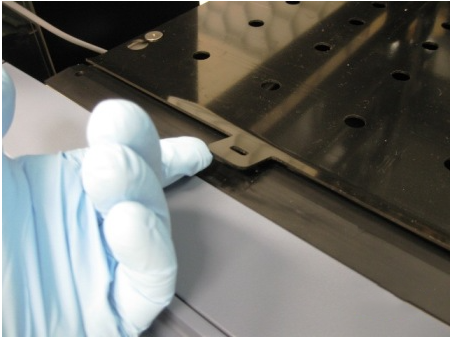
 Lift the tab at the back of the shutter above the shutter actuator pin so that the shutter can slide back to be removed.
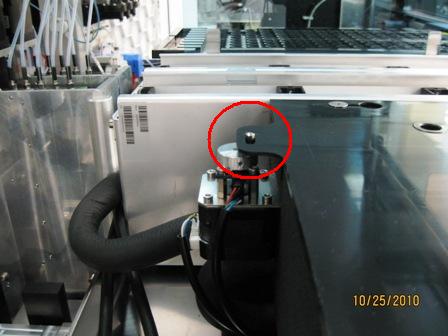
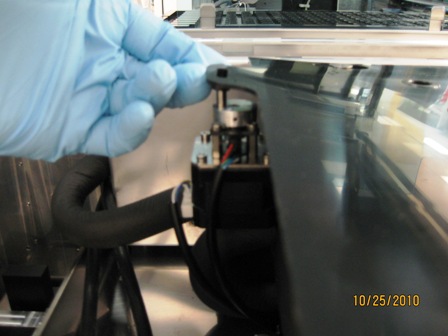
- Slide the shutter toward the back of the system.
- Lift the shutter up and remove.
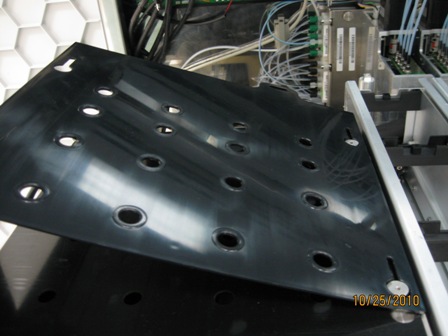
- Remove the Reagent Bay Cover.
- Lift the tab and slide lid toward the back of the system.
- Disconnect both of the liquid cooling lines by pushing in and turning counter-clockwise.
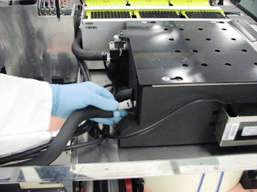
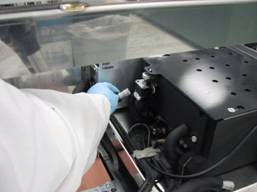
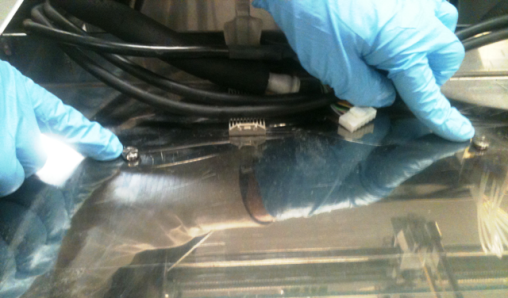
- Disconnect the power/CAN cable by pressing its latch and unplugging it from the printed circuit board located at the rear of the module.
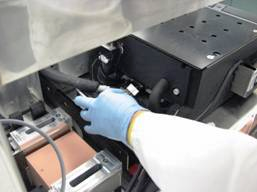
- Open the cable retainer.
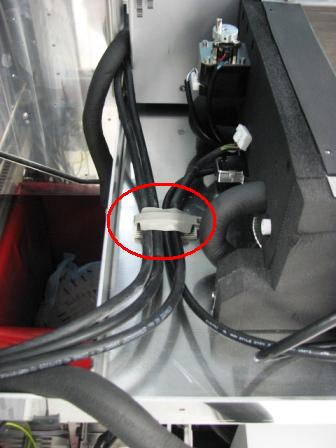
- Remove the front cover from the system.
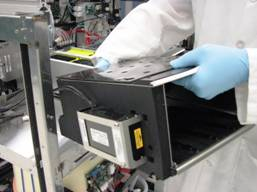
- Using the long 4 mm hex wrench, remove the two 5 mm x 8 mm screws on the left and right sides toward the front of the module. These screws are covered by foam insulation that will need to be displaced in order to access the screws.
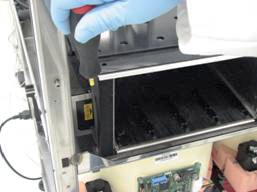
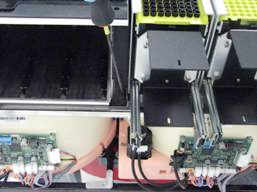
- Slide the module toward the front of the system to clear the two rear shoulder screws. The module should be free of the system and can be removed by lifting.
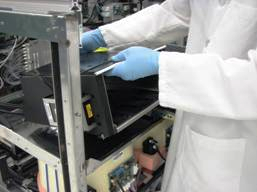
Replacement Procedure
- Place the module in the system so that the rear slotted tabs are underneath the shoulder screws.
- Using the long 4 mm hex wrench, install the two 5 mm x 8 mm screws on the left and right sides toward the front of the module. These screws are covered by foam insulation that will need to be displaced in order to access the screws.
- Connect the power/CAN cable into the printed circuit board located at the rear of the module.
- Connect both of the liquid cooling lines by pushing in and turning clockwise. The tubing that connects to the sample bay should be connected to the left fluid connection when viewed from the rear of the bay.
- Route and secure cables with cable retainer.
- Install the Reagent Bay cover.
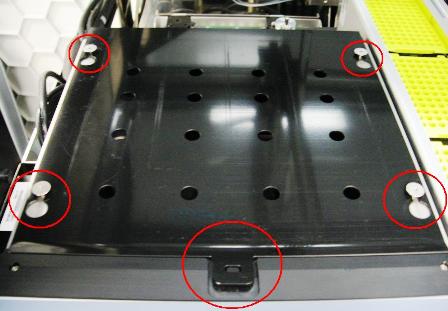
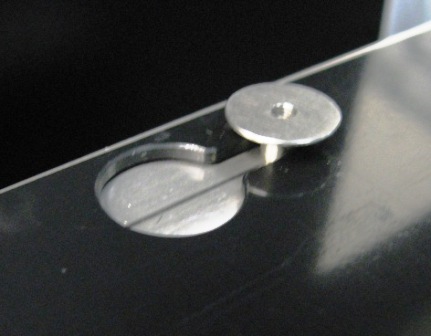
- Place the cover on the bay so that the retainer heads are through the keyhole openings for the retainer heads.
- Slide the cover toward the front of the system until the front tab snaps into place.
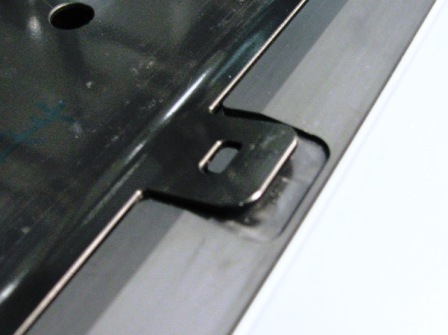
- Make sure all four retainers are properly seated through the cover.
- Install the Reagent Bay shutter.
- Place the Reagent Bay shutter into position.
- While lifting the actuator tab over the actuator pin, slide the cover into position so that the four retainer heads are properly seated in the keyhole slots.
- Position the actuator drive pin into the shutter actuator slot.
- Make sure all retainer heads are properly seated through the shutter keyhole slots.
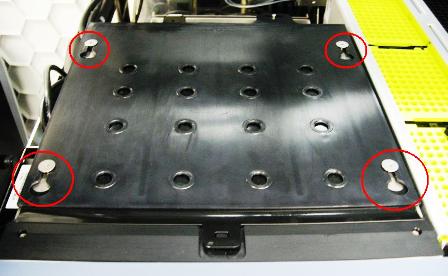
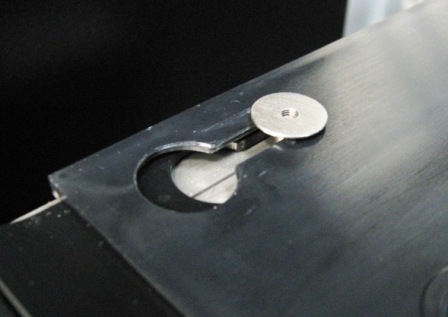
- Verify that all fluid and electrical connections are properly seated, all screws are in place, and lid and shutter are properly installed.
- Install the front cover of the system.
Alignment/Calibration
- Run Instrument Setup to install firmware to the module.
- Auto-teach the Reagent Pipettor to the Reagent Bay.
Verification
- Start up Service Software.
- Using Service Software, verify that the Reagent Bay temperature is within acceptable range.
- Using Service Software, open and close the shutter and visually confirm that it operates properly.
- Scan racks with reagent bottles in all four lanes.
- Verify the detection of rack presence.
Click the  button at the top of the page to send feedback, comments, or change requests.