Barometric vs Capacitive Liquid Level Detection
Description
The Reagent and Sample Pipettors have the same the same Barometric Liquid Level Detection (bLLD) and Capacitive Liquid Level Detection (cLLD Capacitive liquid level detection) components.
AssayProcedures required to prepare and perform a specific test. In the context of this document, assay refers exclusively to a Hologic test, such as Aptima Combo or Ultrio. SW v5.3 and older used bLLD at all Reagent bottle positions and cLLD in the Sample Dispense slot and bLLD at all other positions.
Assay Software v5.3 and above has enabled cLLD for all positions on both the Sample Pipettor and Reagent Pipettor.
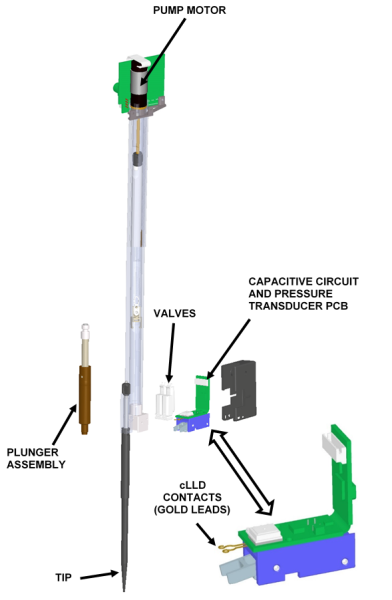
bLLD Pipetting
- As the pipettor moves down in the Z-direction, a pump motor moves a plunger down, causing positive pressure.
- When the tip contacts liquid, the pressure transducer detects a spike in pressure.
- If the pressure spike is large enough, the pipettor stops and proceeds to aspirate / dispense as needed.
A valve prevents the plunger from blowing bubbles while traveling to full extension. - If a spike does not occur, the pipettor travels to the bottom of the bottle or tube and reports that no liquid was found.
cLLD Pipetting
- As the pipettor moves down in the Z-direction, the cLLD contacts measure an electrical signal.
- When the tip contacts liquid, the frequency of the signal spikes (increases).
- If the electrical signal spike is large enough, the pipettor stops and proceeds to aspirate/dispense as instructed.
- If a spike does not occur, the pipettor travels to the bottom of the bottle or tube and reports that no liquid was found.
Advantages of cLLD over bLLD
- Failed bLLD components (such as the pump motor, gearbox, and plunger assembly) are not repairable.
- cLLD does not use the pump motor or plunger, thus reducing wear and extending the life of the pipettor.
- cLLD trace and curve data is saved to provide detailed troubleshooting information.
- Using cLLD allows for an immediate retry reducing the number of failed LLD events and save on lost tests.
- Cleaning cLLD contacts (gold leads) resolves some VVFS errors without replacing the pipettor.
Important Notes
- cLLD is susceptible to droplets on the walls of smaller reagent vessels (100 TK).
Use caution when handling to minimize droplets. - Incorrect TCRTarget capture reagent—An assay-specific reagent added as part of specimen pipetting. Carousel positioning can cause a tip to scrape the bottle opening as it enters. This can create an LLD High event.
Ensure TCR carousel teaching and bottle position are accurate. - If excessive VVFS flags are generated (typically > 2.5% per 2000 tests) then perform the Pipettor DiTi Cleaning Procedure before replacing the pipettor. (Check the One-Day Health Report.)
- cLLD & bLLD Test Procedure is outlined here
 button at the top of the page to send feedback, comments, or change requests.